Barbell Shrugs: Proper Form and Muscles Worked
Barbell shrugs build the upper traps faster than almost any move. Learn proper form, muscles worked, grip strategy, and how to program them.
Medical Disclaimer: This content is for informational purposes only and is not a substitute for professional medical advice. Consult a qualified healthcare provider before starting any new fitness or supplement program.
In this article
Few exercises load the trapezius as directly as the barbell shrug. The movement looks almost too simple, you hold a loaded bar and lift your shoulders, yet most lifters leave size on the table by rolling their shoulders, cutting the range short, or chasing weight they cannot actually control. Done well, barbell shrugs build thick upper traps that round out your physique and reinforce nearly every heavy pull. Getting the form right, knowing which muscles you are training, and programming the lift sensibly is what guarantees progress.
Muscles Worked by the Barbell Shrug
Put simply, the barbell shrug is an isolation movement built around elevating the shoulder blades. The prime mover is the upper trapezius, the broad muscle that runs from the base of the skull down the upper back and out to the shoulder blade. Its upper fibers elevate and upwardly rotate the scapula. You can read more about how the trapezius is built and what it does in the NCBI anatomy reference.
A few supporting muscles also contribute during the movement. The levator scapulae helps lift the shoulder blade, the rhomboids stabilize it, and your forearm flexors work hard just to keep the bar in your hands.
How to Perform the Barbell Shrug
Setting up well is most of the battle here. The path the bar travels is short, so small errors get magnified.
Setup
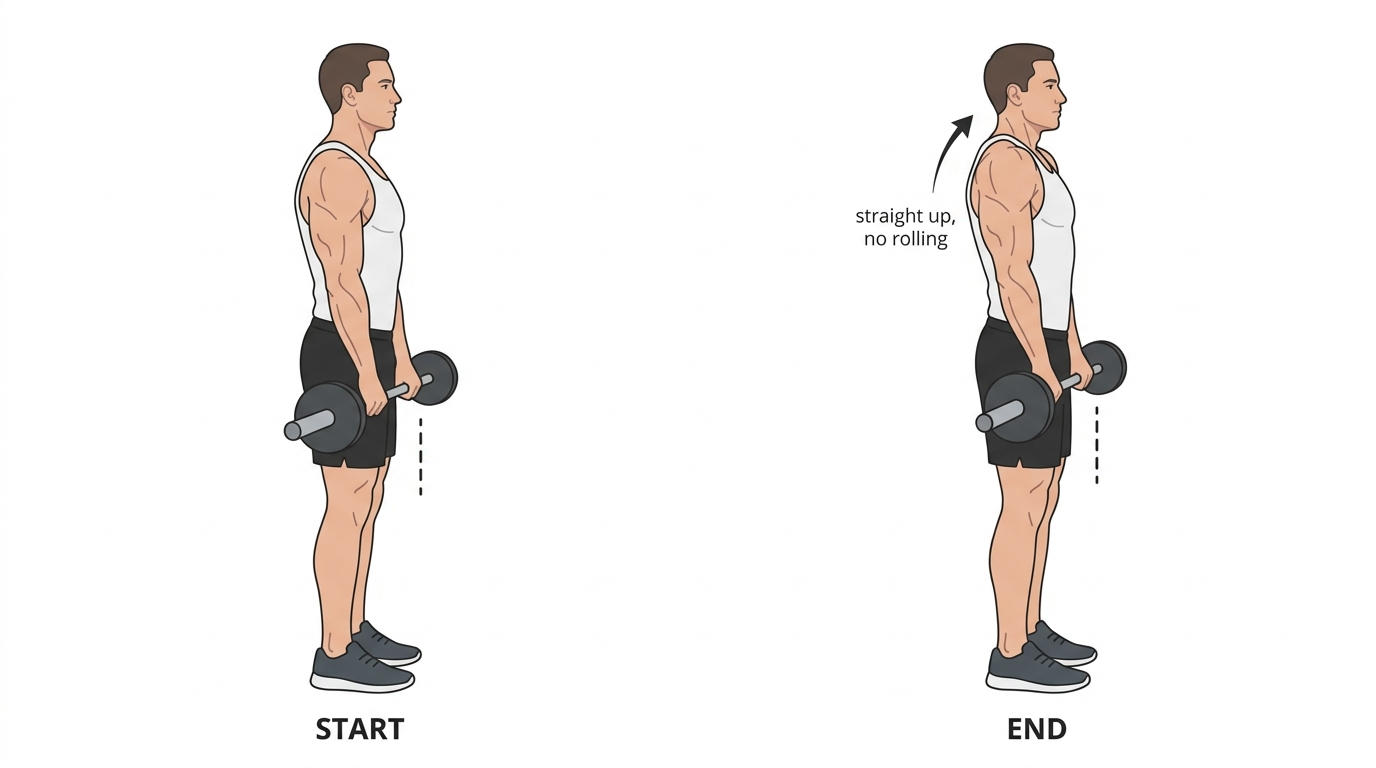
Stand tall with your feet about hip-width apart and the bar resting against your thighs. Use a double overhand grip just outside your hips, arms straight. Brace your core, lift your chest, and let your shoulders relax fully downward so that the traps start in a lengthened position. This bottom position is your true starting point, not a half-raised shrug.
Shrugging
Drive your shoulders straight up toward your ears, as high as they will go. Keep your arms locked straight, because this is a shoulder movement and not a curl or an upright row. Pause for a moment at the top and squeeze the traps hard. Resist the urge to roll your shoulders forward or backward, since that adds nothing useful and stresses the joint.
Lowering
Lower the bar under control instead of letting it drop. Let your shoulders travel all the way back down until the traps are fully stretched at the bottom. A slow, controlled lowering phase keeps tension on the muscle and protects your shoulders.
Common Mistakes That Limit Trap Growth
Rolling the shoulders. Circling the shoulders forward or back during a shrug feels like you’re doing extra work, but it grinds the AC joint and takes time from the actual muscle contraction. Move the bar straight up and straight down, nothing more.
Bending the arms. Once your elbows bend, the biceps and forearms start carrying part of the load. Keep your arms straight and treat them as cables connecting the bar to your shoulders. If you can’t move the weight without elbow bend, it’s too heavy.
Heavy partial reps. Loading the bar so heavy that you can only twitch it up an inch or two trains a slice of the range and leaves most of the muscle untouched. Strip weight until you can hit a full shrug with shoulders close to your ears at the top.
Forward neck movement. Pulling the head forward to meet the bar at the top strains the cervical spine and changes nothing about the contraction. Keep your gaze neutral, looking straight ahead, and let the shoulders do the moving. The bar comes up to you, you don’t come down to it.
Grip and When to Use Straps on Barbell Shrugs
On shrugs, your grip usually gives out long before your traps do. The traps are strong and the range is short, so you can handle serious weight, often more than your fingers can hold for a full set.
There is a smart way to manage this. On your lighter warm-up and back-off sets, hold the bar with a raw double overhand grip and let your grip strength build naturally over time. Then, on your heaviest top sets, where grip would otherwise cut the set short, use lifting straps so that trap fatigue ends the set, not your hands. If you are not sure which pair to get, check out best lifting straps guide.
How to Program Barbell Shrugs
Barbell shrugs work best as accessory work rather than the centerpiece of a session. Put them in at the end of a pull day or a back day, after your heavy rows and deadlifts are already Done. They pair naturally with the big compound exercises for building muscle, filling in direct trap work that those lifts only hit indirectly.
For sets and reps, moderate to high volume tends to suit the traps well. Something like two to four sets of eight to fifteen reps gives you enough quality contractions without forcing you into sloppy partials.
Working Weight Benchmarks for the Barbell Shrug
Trap strength varies widely, but these rough benchmarks give you a sense of where you stand. They are expressed as a percentage of your bodyweight on the bar.
Beginner Anywhere from the empty bar up to roughly your bodyweight on the bar, performed with clean form and a full range.
Intermediate Around one and a quarter to one and a half times your bodyweight for controlled sets in the ten to fifteen rep range.
Advanced Roughly twice your bodyweight or more, usually with straps on the heaviest sets and still moving through a complete range.
For very heavy sets, a weightlifting belt is a smart choice.
Making Barbell Shrugs Count
Barbell shrugs are about as simple as a strength exercise gets, and that is their advantage. You do not need any special equipment beyond a loaded bar, the learning curve is short, and almost anyone can start training their traps directly from their first session.
Treat the movement with the same respect you give your bigger lifts. Use a full range, a controlled tempo, and weight you can actually own. Add them to the end of your pulling days, stay patient through the lighter sets, and the results will follow.
Frequently Asked Questions
Are barbell shrugs worth doing?
Should you roll your shoulders when doing shrugs?
How heavy should you go on barbell shrugs?
Are barbell or dumbbell shrugs better?
Do barbell shrugs work the neck?
Continue reading
Barbell Upright Row: Form, Grip Width, and Safety
Learn proper barbell upright row form, the best grip width, the shoulder impingement risk, and when alternatives like lateral raises are smarter.
Best Lifting Straps: Top Picks (2026)
The best lifting straps for deadlifts, rows, and heavy pulls. We compare lasso, figure 8, and padded straps across 6 top picks.
Best Compound Exercises for Building Muscle
The best compound exercises for building muscle, organized by movement pattern. Plus how to balance compounds with isolation work.
Free newsletter
Evidence-based fitness and health insights, delivered to your inbox.
No spam. Unsubscribe at any time.
Thanks for subscribing!