Barbell Upright Row: Form, Grip Width, and Safety
Learn proper barbell upright row form, the best grip width, the shoulder impingement risk, and when alternatives like lateral raises are smarter.
Medical Disclaimer: This content is for informational purposes only and is not a substitute for professional medical advice. Consult a qualified healthcare provider before starting any new fitness or supplement program.
In this article
What Is the Barbell Upright Row
The barbell upright row is a vertical pulling exercise in which a barbell is lifted from arms-length at the thighs up toward the chest while the elbows lead the movement out and slightly upward. The lift primarily trains the medial (side) head of the deltoid and the upper trapezius. Most people perform it standing with a moderate-weight load and moderate rep ranges.
The barbell upright row is best classified as a shoulder isolation accessory lift, not a compound primary. While multiple joints move, the exercise effectively trains one main muscle group with a secondary contribution from the upper traps. This classification matters for how it should be programmed: lighter weights, higher reps, accessory placement in the session, never a primary strength-test movement.
It is also one of the more controversial exercises in strength training. Done with a narrow grip and pulled all the way to the chin, the lift creates a well-documented shoulder impingement geometry. Done with a wider grip and stopped at chest height, the risk drops substantially. The full safety discussion comes later in this article, but it is worth setting the expectation up front: this lift is safe for most healthy lifters who use the right form, and unsafe for some lifters regardless of form.
Muscles Worked in the Barbell Upright Row
The barbell upright row is a relatively focused exercise.
The medial deltoid is the primary mover. This is the side head of the shoulder, the muscle that creates the rounded “capped” shoulder look when developed. It works hardest when the elbows travel out laterally during the pull.
The upper trapezius assists with the shrugging component of the movement, particularly in the upper half of the range. A narrower grip shifts more emphasis to the upper traps.
The anterior deltoid contributes a minor assisting role, mainly toward the top of the lift as the bar approaches the chest.
The forearms and grip work isometrically to hold the bar throughout the set. Forearm fatigue rarely limits this exercise.
Note what is NOT a primary mover: the biceps. If the biceps are doing significant work during your upright rows, the form is off. The biceps should be incidental contributors, not drivers. Their involvement is typically a sign that the lifter is rowing with the arms rather than leading with the elbows.
How to Perform the Barbell Upright Row
Setup
Stand upright with feet shoulder-width apart. Hold a barbell with a pronated (overhand) grip, hands placed just outside shoulder width. This is the recommended grip width for most lifters and matches the geometry that produces the safest and most effective version of the lift.
Let the bar hang at arms-length in front of your thighs. Keep your arms fully extended, shoulders pulled back and down, chest up, and core braced. The wrists should be neutral, in line with the forearms, not bent.
Pulling
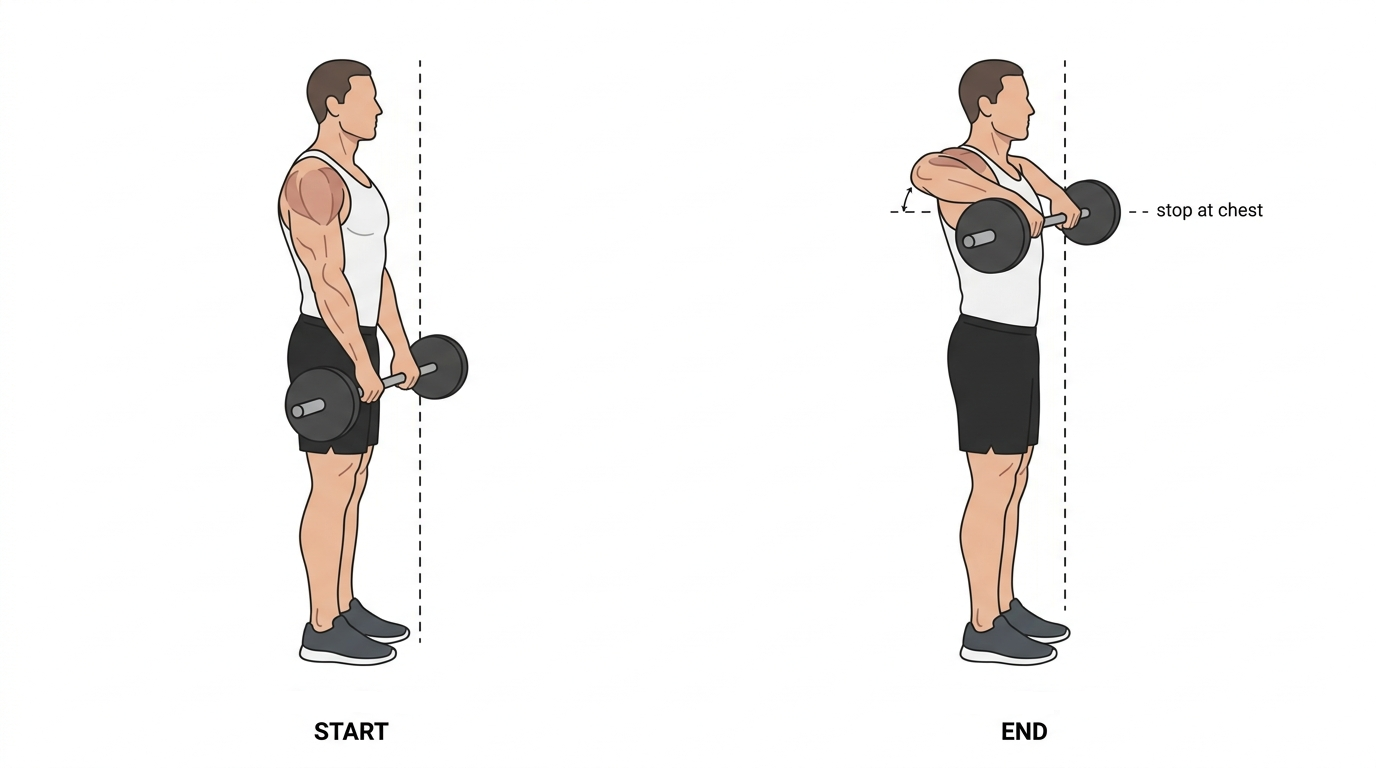
Initiate the lift by leading with your elbows, not by curling the bar up with your arms. Drive the elbows out laterally and slightly upward. The bar travels straight up close to (but not touching) the body. Maintain neutral wrists throughout, do not let them bend inward as the bar rises.
Pull only until the bar reaches mid-chest height, with the elbows roughly at shoulder level. Stop there. Do not continue pulling toward the chin. Pulling higher is where the impingement risk lives, and the additional range provides no additional muscle activation benefit.
Lowering
Reverse the movement under control. Lower the bar back to the starting position at the thighs, fully extending the elbows. The eccentric phase should be at least as controlled as the concentric, ideally slightly slower. No bouncing at the bottom, no resting the bar on the thighs between reps.
Grip Width and Bar Path
Grip width is the single most important variable for both effectiveness and safety in the barbell upright row.
Wide grip (just outside shoulder width). The recommended default for most lifters. Maximizes medial deltoid recruitment, minimizes biceps involvement, reduces the internal rotation of the humerus that contributes to impingement risk.
Shoulder-width grip. A reasonable middle option, biased slightly more toward the upper traps than the wider grip. Still acceptable if it feels stronger for your build.
Narrow grip (inside shoulder width). Emphasizes the upper traps more than the medial deltoid, and increases the internal rotation of the humerus. This is the highest-risk grip and the one with the most-impingement-prone geometry. Avoid unless you have a specific trap-focused reason to use it.
The bar should travel close to the body but not touching it throughout. Forcing the bar to brush against your torso actually increases internal rotation at the shoulder and works against the safer wide-grip geometry.
The Shoulder Impingement Concern
The barbell upright row has a long-standing reputation as a “shoulder-killer” exercise, and that reputation is partly earned and partly overblown. Understanding the actual mechanism helps you decide what to do.
The shoulder joint has a small space between the head of the upper arm bone (the humerus) and the bony arch above it (the acromion). Through this space pass the rotator cuff tendons and a fluid-filled bursa. When you raise your arm above shoulder height while the humerus is internally rotated (the position the upright row forces), the humeral head can compress these structures against the acromion. Repeated compression over many sessions and many years can cause inflammation, tendon irritation, and the cluster of symptoms known as subacromial impingement syndrome.
A study by Kolber and colleagues examined shoulder joint and muscle characteristics in recreational weight-training participants with and without subacromial impingement syndrome. They found that lifters with impingement syndrome showed specific muscular imbalances and range-of-motion deficits, and that intrinsic risk factors (rather than just “bad form”) play a major role in who develops the condition. In other words, two lifters can perform the same exercise with the same technique and one can develop impingement while the other does not, because of differences in their underlying joint anatomy and muscular balance.
Who is at high risk:
- Lifters with a personal history of shoulder impingement, rotator cuff injury, or chronic shoulder pain
- Lifters with naturally narrow acromial space (often only diagnosable via imaging, but suspected if you have recurring shoulder problems)
- Lifters with significant muscular imbalances between internal and external rotators of the shoulder
- Lifters who already train shoulders heavily through other movements like the barbell shoulder press and lateral raises
Practical recommendation:
For healthy lifters with no history of shoulder problems, the wider-grip + stop-at-chest version is safe and effective. Use this version and not the “traditional” chin-height-narrow-grip one.
For high-risk lifters, swap the upright row entirely for dumbbell or cable lateral raises. These movements train the medial deltoid at least as effectively without forcing the humerus into the impingement geometry. If the upright row produces shoulder pain or discomfort of any kind, stop doing it and switch to a lateral raise variation.
Common Barbell Upright Row Mistakes
Pulling too high. Bringing the bar to chin level or higher puts the elbows above shoulder height with the humerus internally rotated, the textbook impingement position. The fix is to stop the bar at mid-chest with the elbows at roughly shoulder level. No higher.
Using a narrow grip. Hands inside shoulder width increases the internal rotation of the humerus and is the highest-risk geometry. The fix is to widen the grip to just outside shoulder width.
Wrists bending inward. Many lifters allow their wrists to fold as the bar rises, which puts strain on the wrist joints and disconnects force transfer. The fix is to keep the wrists neutral throughout, in line with the forearms.
Biceps doing the work. If you feel the lift mostly in your biceps, you are rowing with your arms rather than leading with your elbows. The fix is to consciously drive the elbows outward and upward, not pull the bar up with the hands.
Jerking the weight. Using momentum from the legs or hips to start the lift defeats the purpose of an isolation exercise and adds risk. The fix is to use lighter weight and execute every rep with a deliberate, controlled tempo.
Hunching the upper back. Allowing the shoulders to round forward as you pull weakens the lift and worsens the impingement geometry. The fix is to keep the shoulders pulled back and down throughout, chest up, upper back engaged.
Forcing bar contact with the body. Some coaching cues say to “drag the bar up the body.” This actually increases internal rotation. The fix is to keep the bar close but not touching, traveling in a straight vertical path a few inches in front of the torso.
Working Weight Benchmarks for the Barbell Upright Row
Because this is an accessory shoulder lift, not a strength-test movement, benchmarks are expressed in absolute weights for working sets of 8 to 12 reps, not one-rep max attempts.
Beginner. Men typically work with 20 to 30 kg (45 to 65 lb). Women typically work with 10 to 15 kg (22 to 33 lb). At this level the lifter is establishing the movement pattern and learning to lead with the elbows.
Intermediate. Men typically work with 35 to 45 kg (75 to 100 lb). Women typically work with 20 to 25 kg (44 to 55 lb). The movement pattern is locked in, and the lifter can maintain clean form across multiple working sets.
Advanced. Men typically work with 50 to 60 kg (110 to 130 lb). Women typically work with 30 to 35 kg (66 to 77 lb). At this level the upright row is a small but well-developed component of a broader shoulder program.
These are working set numbers, not max attempts. The upright row is not a lift to chase heavy weights on. Form deteriorates quickly past moderate loads, and the cost-benefit of heavy upright rowing (risk of shoulder injury vs. marginal extra hypertrophy) is poor compared to staying moderate and progressing slowly.
Programming the Barbell Upright Row
Place the upright row late in a shoulder or push session, after primary work like the overhead press and any other heavy compound lifts. Treat it as accessory work.
Sets and reps should target hypertrophy rather than strength: 2 to 4 sets of 8 to 15 reps. The research on rep ranges and muscle growth supports this range as effective for hypertrophy when sets are taken close to failure. Rest 60 to 90 seconds between sets, similar to other isolation work.
Frequency: 1 to 2 times per week as part of shoulder or push training. More than twice per week tends to accumulate shoulder fatigue without proportional growth benefit, particularly when combined with overhead pressing.
Where this fits in a broader compound-lift-focused program: treat it as a finishing accessory for medial deltoid development, not as a substitute for any primary shoulder pressing or rowing pattern. If shoulder mobility is limited or if any version of the upright row produces discomfort, replace it with dumbbell lateral raises or cable lateral raises immediately. These alternatives match or exceed upright row effectiveness for medial deltoid development without the joint stress.
Takeaway
The barbell upright row earns its place in shoulder programming when it is done with the right grip and the right range of motion. Wide grip, stopping at chest height rather than chin height, moderate loads, and accessory placement in the session. Done this way it is a useful tool for medial deltoid development and upper trap work.
Frequently Asked Questions
Is the barbell upright row bad for your shoulders?
How high should you pull the bar on a barbell upright row?
Which grip width is best for the barbell upright row?
Can I replace the barbell upright row with lateral raises?
How heavy should I go on barbell upright rows?
Are barbell upright rows worth doing at all?
Continue reading
Barbell Shoulder Press: Form, Muscles Worked & Variations
Master the barbell shoulder press with proper form, bar path mechanics, grip width, and mobility requirements for safe, strong overhead pressing.
Best Compound Exercises for Building Muscle
The best compound exercises for building muscle, organized by movement pattern. Plus how to balance compounds with isolation work.
How Many Reps to Build Muscle: The Answer
How many reps to build muscle? Research shows 5-30 reps all work if sets approach failure. Here is what actually matters.
Free newsletter
Evidence-based fitness and health insights, delivered to your inbox.
No spam. Unsubscribe at any time.
Thanks for subscribing!