How to Do Kettlebell Swings: Form, Style, and Weight
Learn proper kettlebell swing form, the Russian vs American swing trade-off, weight selection, and programming for power or conditioning.
Medical Disclaimer: This content is for informational purposes only and is not a substitute for professional medical advice. Consult a qualified healthcare provider before starting any new fitness or supplement program.
In this article
What Is the Kettlebell Swing
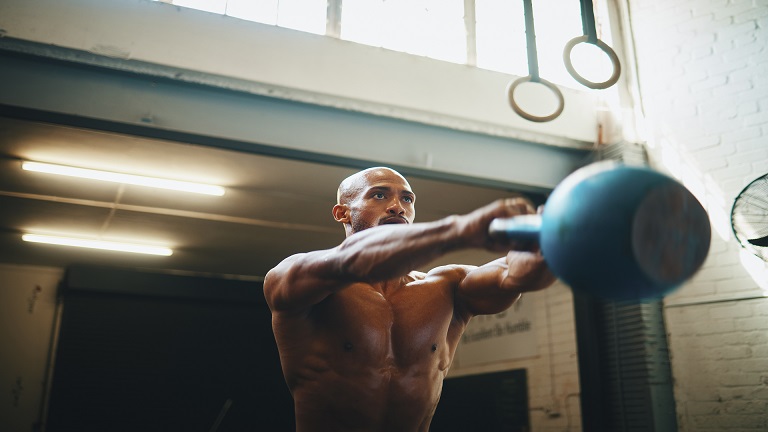
The kettlebell swing is a ballistic hip-hinge exercise in which a kettlebell is propelled forward by an explosive hip extension and allowed to swing back between the legs. The arms do not lift the bell, they function as ropes that transmit force from the hips to it. Most of the work happens at the hips, glutes, and posterior chain.
The swing is the foundational kettlebell movement and the gateway to almost every other ballistic kettlebell exercise. It trains explosive power, posterior chain strength, and cardiovascular conditioning in a single pattern. Equipment requirements are minimal: one kettlebell of the appropriate weight and enough floor space to swing the bell freely in front of you.
There are two distinct schools of swing technique: the hardstyle swing (associated with StrongFirst and the RKC system) which emphasizes maximum power per rep with the bell “floating” at the top, and the sport (Girevoy) swing emphasizes efficiency for high-volume competition use. The hardstyle approach is what most lifters should learn first.
Muscles Worked in the Kettlebell Swing
A biomechanical study by McGill and Marshall mapped the kettlebell swing’s muscle activation sequence and identified the following primary contributors.
The glutes drive hip extension at the top of every rep. This is the prime mover of the swing and the muscle the exercise is most associated with developing.
The hamstrings stretch under load during the hinge and contribute to hip extension on the way up. They also brake the bell on the descent.
The spinal erectors maintain spinal extension throughout the lift, preventing the lower back from rounding under load.
The core, including the rectus abdominis, transverse abdominis, and obliques, braces against flexion forces and stabilizes the trunk during the explosive hip drive.
The lats controls the bell during the descent and helps “pack” the shoulders into a stable position, preventing the arms from being yanked out of socket.
The forearms and grip work isometrically to hold onto the bell rep after rep. Grip is often the first thing to fatigue in high-rep sets.
How to Perform the Kettlebell Swing
Setup
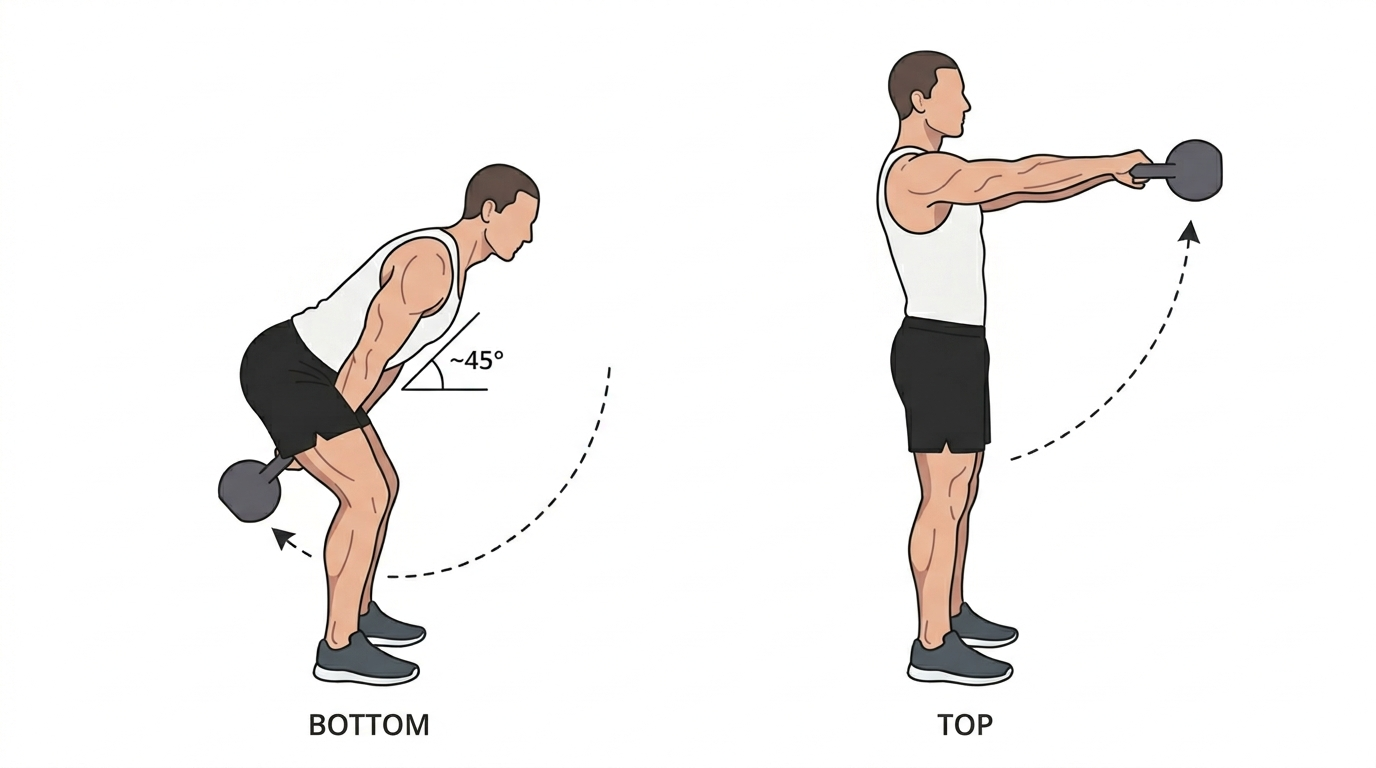
Place the kettlebell on the floor about 12 to 18 inches in front of your feet. Stand with feet shoulder-width apart and toes pointed forward or slightly out. Hinge at the hips (not the knees) to reach down and grip the kettlebell handle with both hands. Pull your shoulders back and down to engage the lats. Brace your core as if preparing for a punch. Maintain a neutral spine from head to tailbone.
The Snap
Begin by snapping the kettlebell back between your legs in a sharp, explosive backward sweep, as if hiking a football to someone behind you. Your weight shifts back over your heels and midfoot. The bell travels HIGH between your thighs, ideally above the level of your knees on the back swing. Bent arms during the hike or starting the bell from in front of the feet are common errors that disrupt the entire set.
The Drive
Reverse direction at the top of the back swing by snapping your hips forward explosively. The hip drive propels the kettlebell forward and up. Your body forms a rigid vertical plank at the top of the swing: glutes squeezed, abs braced, quads locked, no leaning back. The kettlebell should “float” at chest height under its own momentum. If you have to muscle the bell up with your arms or shoulders, the hip drive was insufficient. Let the bell fall back into the hinge with control, and immediately transition into the next rep without pause.
Russian vs American Swing
The two main swing variations differ in how high the bell travels.
The Russian swing brings the kettlebell to roughly chest or shoulder height at the top. This is the default in hardstyle training and the version associated with most kettlebell research. It emphasizes maximum hip power per rep without requiring overhead mobility, and it’s the safer choice for most lifters.
The American swing continues the bell all the way overhead until the arms are fully extended above the head. Popular in CrossFit, this style adds shoulder work and increases total range of motion. Research by McGill and Marshall documented higher shear loads on the lumbar spine in the overhead variation, and the movement demands excellent overhead shoulder mobility and intact rotator cuff health to perform safely. Lifters with shoulder mobility limitations or pre-existing rotator cuff issues should avoid it.
Recommendation: default to the Russian swing unless you have a specific reason (such as CrossFit programming or sport competition) that requires the American version. The Russian swing delivers most of the benefit with significantly less risk.
Common Kettlebell Swing Mistakes
Squatting instead of hinging. If your knees are bending more than your hips and your thighs are dropping below parallel, you are squatting the swing. The fix is to keep the knees only slightly bent throughout and drive the hips backward, not the knees forward. Your hamstrings should feel a stretch at the bottom of every rep.
Using the arms to lift. The arms should hang relaxed throughout and act only as ropes. If your shoulders or biceps are working hard, you are lifting the bell instead of letting the hips throw it. The fix is to think “hips drive, arms float.”
Hyperextending the lower back at the top. Leaning back at the top of the swing creates shear load on the lumbar spine. The body should form a vertical line, not a backward arc. The fix is to squeeze the glutes and brace the abs at the top to keep the pelvis tucked, not tilted forward.
Swinging too high (Russian variation). The Russian swing should top out at chest or shoulder height, not higher. Bell going to eye level or above usually means the lifter is forcing it up with arms after the hip drive is exhausted.
Bell drifting too far from the body in the descent. Letting the bell swing out in front of you on the way down creates excessive lower-back load. The cue is “tame the arc”: keep the bell close enough that it brushes the inside of your thighs as it travels back down through the hinge.
Vertical torso at the bottom of the hinge. If your chest is upright at the bottom of the swing, you are squatting. The torso should be roughly parallel to the floor or slightly above at the deepest point of the hinge, with a flat back.
How to Choose Your Kettlebell Weight
The kettlebell swing is a power exercise, not a strength exercise. This changes how to think about loading.
For most lifters, men should start with a 16 kg (35 lb) kettlebell and women should start with 8 to 12 kg (18 to 26 lb). These weights are heavier than what beginners typically reach for and that is intentional. With a too-light bell, the lifter ends up pulling the kettlebell up with arms and shoulders because the hip drive overpowers the bell. The bell should fight you a little. It should require committed hip drive to float at the top.
A useful test for whether your bell is heavy enough: at the top of the swing, the kettlebell should feel weightless for a brief moment, suspended by its own momentum. If you can’t feel that float because the bell is barely moving, it’s too light. If you can’t get the bell to chest height at all, it’s too heavy for now.
Progress weights gradually. Most lifters can move from a 16 kg to a 24 kg bell within a few months of consistent training, and from 24 kg to 32 kg over the next year.
Working Weight Benchmarks for the Kettlebell Swing
Unlike squats or deadlifts, the kettlebell swing isn’t measured by one-rep max. Benchmarks reflect the heaviest bell you can swing with clean hardstyle form for at least 10 consecutive reps.
Beginner. Men typically swing 16 kg (35 lb). Women typically swing 8 to 12 kg (18 to 26 lb). At this level the lifter has the basic hip hinge pattern locked in and can perform sets of 10 reps without form deterioration.
Intermediate. Men typically swing 24 kg (53 lb). Women typically swing 16 kg (35 lb). The lifter is now comfortable with the explosive hip drive and can sustain form through longer sets and progressive sessions.
Advanced. Men typically swing 32 kg (70 lb) or heavier. Women typically swing 20 to 24 kg (44 to 53 lb) or heavier. At this level, the swing has become a deeply trained motor pattern and the lifter can move serious weight with sharp, snappy form.
These benchmarks are working weights, not max attempts. A lifter who can grind out a single rep with a heavier bell is not necessarily at that tier.
Programming the Kettlebell Swing
The swing serves two distinct training goals, each requiring its own protocol.
For power development. Use a heavy kettlebell (challenging but allowing perfect form), perform 5 to 10 sets of 5 to 10 reps, and rest 2 to 3 minutes between sets. This protocol borrows from how research on kettlebell training has shown improvements in half-squat 1RM and vertical jump height over 6-week programs. Heavy and powerful, not exhausting.
For conditioning. Use a moderate kettlebell and structure sets with timed intervals. EMOM (every minute on the minute) protocols of 10 to 20 reps per minute for 10 to 20 minutes total work well. Alternatively, 30 seconds on / 30 seconds off intervals for 8 to 12 rounds. The key here is consistent pace and high heart rate, not max-power per rep.
Frequency: 1 to 3 swing sessions per week works fine. In general, you can recover much faster from a swing session than heavy compounds, unless you really went hard on the volume.
Where it fits in the session: place swings early if they are your priority lift for the day and you can also incorporate them in your leg day warm up if you want to. Use them as a conditioning finisher if you are doing them after primary strength work. Avoid pairing heavy power swings with heavy deadlift work in the same session, since both tax the posterior chain.
Takeaway
The kettlebell swing is one of the most efficient exercises ever invented. A single bell and ten minutes of focused work delivers full-body power development, posterior chain hypertrophy, and serious conditioning. The barrier to starting is minimal, while the carryover to athletics, daily life, and other lifts is substantial.
Frequently Asked Questions
Are kettlebell swings bad for your back?
Russian vs American swing, which is better?
How heavy should my first kettlebell be?
How many kettlebell swings should I do per day?
Are kettlebell swings cardio or strength?
Can kettlebell swings replace deadlifts?
Continue reading
Kettlebell Goblet Squat: Form, Benefits & Variations
Master the kettlebell goblet squat with proper form, why it lets you squat deeper, and when to graduate to a barbell.
Dumbbell Romanian Deadlift: Form, Muscles, and Programming
Master the dumbbell Romanian deadlift with evidence-based form cues, range of motion guidance, and a programming framework for stronger hamstrings.
Best Compound Exercises for Building Muscle
The best compound exercises for building muscle, organized by movement pattern. Plus how to balance compounds with isolation work.
Free newsletter
Evidence-based fitness and health insights, delivered to your inbox.
No spam. Unsubscribe at any time.
Thanks for subscribing!