Cable Lateral Raise: Form, Muscles, and Programming
The cable lateral raise isolates the side delt while providing constant tension. Learn the form, the muscles worked, and how to program it.
Medical Disclaimer: This content is for informational purposes only and is not a substitute for professional medical advice. Consult a qualified healthcare provider before starting any new fitness or supplement program.
In this article
If your shoulders look strong head-on but flat from the side, the muscle you need to work on is the lateral deltoid. The lateral deltoid is the side of the shoulder, and it’s what gives the upper body its width and that rounded, capped look. The cable lateral raise is the most direct way to train it, as a cable holds steady tension through almost the whole movement, including the bottom where a dumbbell provides almost zero resistance.
Muscles Worked by the Cable Lateral Raise
The cable lateral raise is an isolation move, so the work lands mostly on one muscle. The lateral deltoid, also called the medial or side deltoid, is the primary mover. It sits on the outer shoulder and drives abduction, lifting the arm out to the side, which is exactly what the raise trains.
A few muscles assist. The supraspinatus, a small rotator cuff muscle, starts the first 15 degrees or so of the lift before the side delt takes over. The upper trapezius stabilizes the shoulder and will take over the movement if you let your shoulder shrug. The anterior deltoid and posterior deltoid contribute a little depending on arm angle, but here they act mostly as stabilizers.
How to Do a Cable Lateral Raise with Good Form
Setup
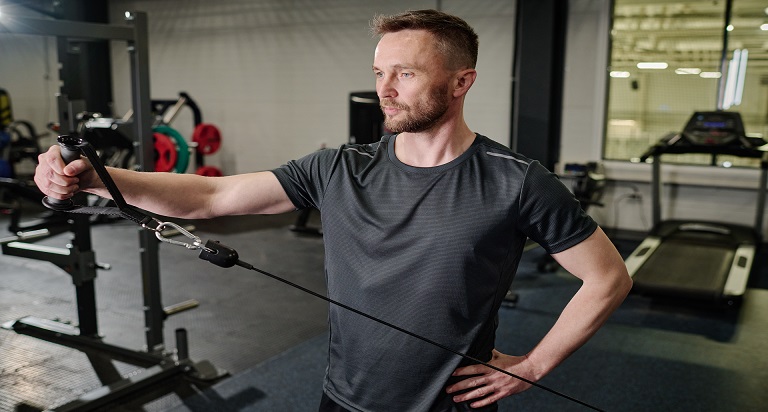
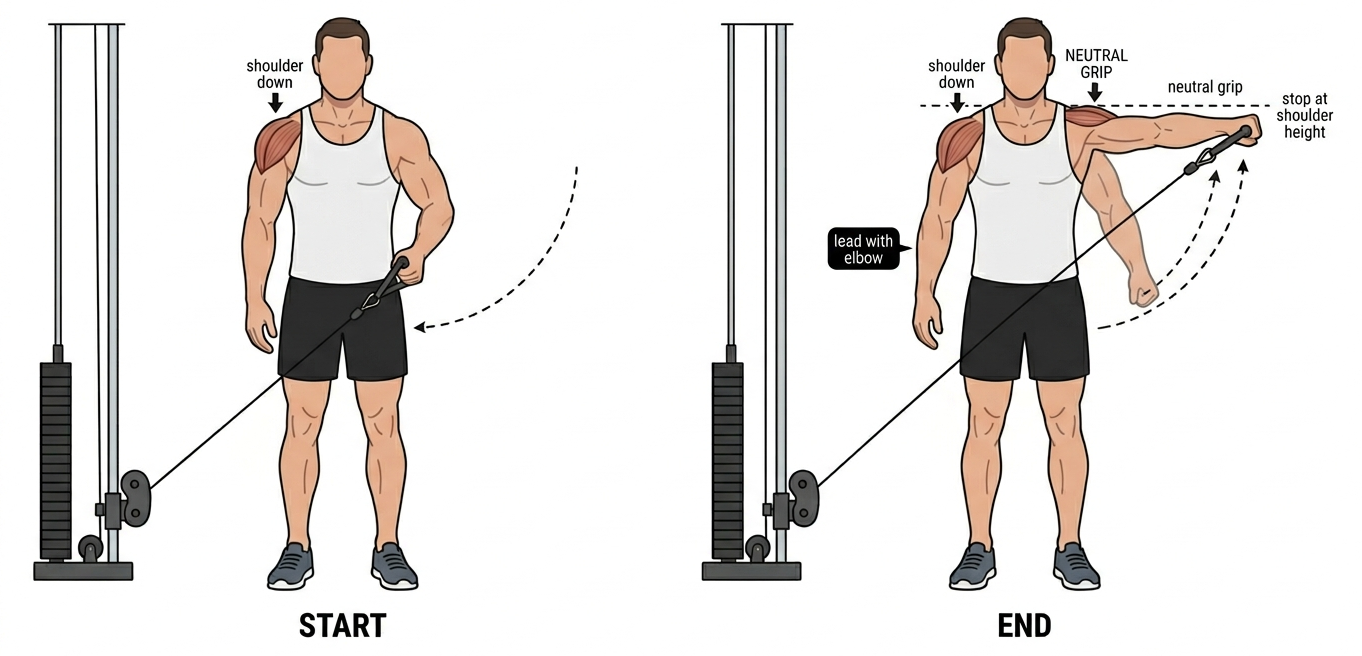
Set the pulley to its lowest point and clip on a single handle. Stand side-on to the machine so your working arm is the one further from the tower, then reach across and take the handle. Keep a soft bend in the elbow, brace your core, and let the cable pull your arm gently across your body. That slight stretch at the bottom is the tension a dumbbell can’t give you down here.
Raising
Raise your arm out to the side in a wide arc, leading with your elbow rather than your hand. Stop when your upper arm reaches roughly shoulder height, so the arm sits about parallel to the floor. Keep your thumb and pinky close to level, with no rotation. Keep the shoulder pulled down and away from your ear the whole way up so the trap can’t hijack the rep.
Lowering
Lower the handle slowly, fighting the cable instead of letting it snap your arm back. This is where the cable earns its keep, since the tension stays high through the bottom. The lowering phase matters as much as the lift, so take two to three seconds coming down. Pause briefly at the bottom without resting, then start the next rep.
Why the Cable Beats Dumbbells
People often feel a lateral raise differently on a cable than with dumbbells, and there’s a mechanical reason for it. Resistance pulls in the direction of the cable, or with a dumbbell, straight down toward the floor. At the bottom of a dumbbell raise your arm hangs straight down and gravity pulls straight down too, so the two line up and the side delt barely works. The dumbbell only loads the muscle as your arm rises and the angle opens, peaking near the top.
A cable changes the geometry. Because the line of pull runs out toward the pulley, the resistance stays closer to perpendicular to your arm through far more of the range, including that bottom stretch. More time under meaningful tension tends to mean more growth stimulus for a small muscle like the side delt. That’s why the cable version is worth the extra setup even though grabbing dumbbells is quicker.
Common Mistakes That Shift Work Off Your Side Delts
Swinging the Weight
If you’re using momentum, the load is too heavy and the side delt is getting a fraction of the work. The lateral raise is one of the few lifts where cheating a little is not acceptable. Drop the weight and slow each rep down so the muscle does the lifting.
Shrugging Your Traps
When your shoulder rides up toward your ear, the upper trap takes over. Push your shoulder down and away before each rep, and keep it there. If you can’t stop the shrug no matter how hard you focus, the weight is too heavy.
Going Above Shoulder Height
Raising the arm well past shoulder height pulls the traps and other muscles into the movement and adds nothing for the side delt. Shoulder height, where the upper arm is roughly parallel to the floor, is the top of a productive rep.
Rushing the Lowering
Letting the cable yank your arm back down throws away the most valuable part of the rep. Controlled lowering is a big part of why the exercise works. Fight the cable for two to three seconds every time.
How to Program the Cable Lateral Raise
The side delt is a small muscle that recovers quickly, so it can handle more frequency than a big compound lift. Two to three sessions a week works well, and you can place it after your heavier pressing when the shoulders are warm but not yet fried. Research on training volume suggests that, within reason, more weekly sets tend to produce more muscle growth (Schoenfeld et al. 2017), which is why a few focused sets spread across the week add up.
Reps belong on the higher end. Three or four sets of 12 to 20 reps with a weight you can control through the full range is a solid target, and beginners should start lighter than feels necessary. Because the cable holds constant tension, even a modest load feels brutal by the last few reps. For more on why rep ranges matter, see our guide to how many reps to build muscle.
Lateral raises are isolation work, so they belong alongside your compound lifts rather than in place of them. Pair them with pressing like the barbell shoulder press, which builds overall shoulder mass but leaves the side head under-stimulated. They also sit well next to the dumbbell front raise for the front of the shoulder and the barbell upright row for a heavier side-delt and trap stimulus. If you’re building a session around the big lifts, check our piece on compound exercises for building muscle.
Takeaway
The cable lateral raise is the most direct way to train the muscle that makes your shoulders look wide, and it does it with a smooth, joint-friendly tension that suits almost everyone. So, add it to your next shoulder day and give it the attention it deserves.
Frequently Asked Questions
What muscles does the cable lateral raise work?
Is the cable or dumbbell lateral raise better?
How heavy should I lift and how many reps?
Why do I feel it in my traps instead of my shoulders?
Should I do one arm or both at once?
Continue reading
Barbell Shoulder Press: Form, Muscles Worked & Variations
Master the barbell shoulder press with proper form, bar path mechanics, grip width, and mobility requirements for safe, strong overhead pressing.
Dumbbell Front Raise: Form, Grip, and When to Skip
Learn proper dumbbell front raise form, grip variations, and when this lift is actually worth doing versus a waste of training volume.
Barbell Upright Row: Form, Grip Width, and Safety
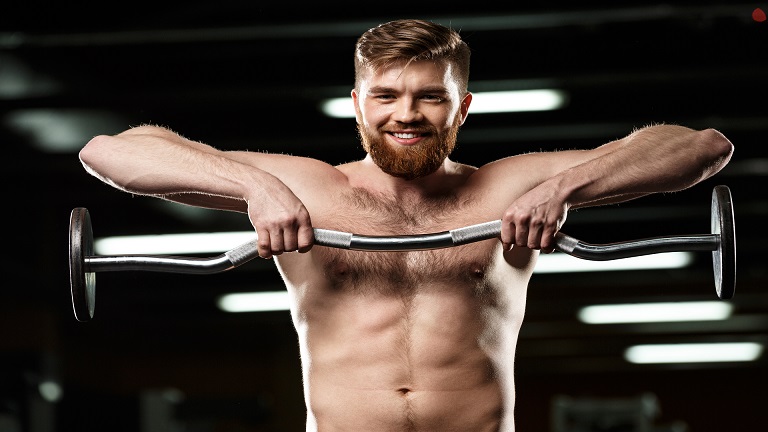
Learn proper barbell upright row form, the best grip width, the shoulder impingement risk, and when alternatives like lateral raises are smarter.
Free newsletter
Evidence-based fitness and health insights, delivered to your inbox.
No spam. Unsubscribe at any time.
Thanks for subscribing!