Dumbbell Front Raise: Form, Grip, and When to Skip
Learn proper dumbbell front raise form, grip variations, and when this lift is actually worth doing versus a waste of training volume.
Medical Disclaimer: This content is for informational purposes only and is not a substitute for professional medical advice. Consult a qualified healthcare provider before starting any new fitness or supplement program.
In this article
What Is the Dumbbell Front Raise
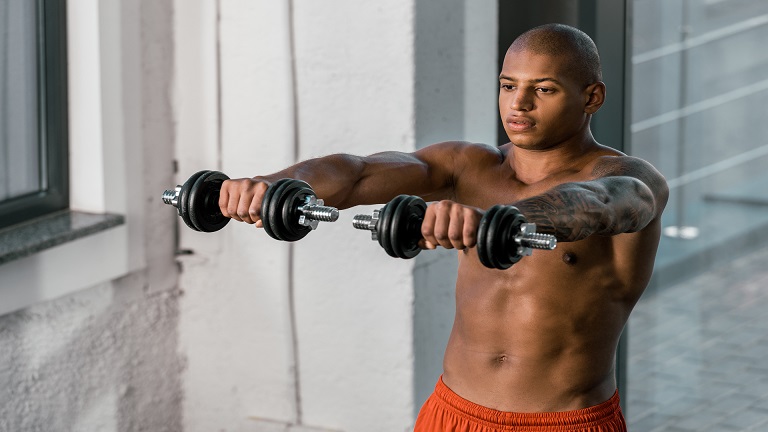
The dumbbell front raise is a shoulder isolation exercise in which a pair of dumbbells is raised forward and up from the front of the thighs to shoulder height, with the arms moving in shoulder flexion (forward) rather than abduction (out to the side). The lift primarily trains the anterior deltoid, the front portion of the shoulder muscle, with significant assistance from the clavicular head of the pectoralis major.
The dumbbell front raise sits in the category of shoulder isolation accessory work. It is not a heavy compound lift and should not be programmed or loaded like one. For most lifters who already do pressing movements as part of their training (bench press, incline bench, overhead press, push-ups), the anterior deltoid is already getting significant work indirectly, which raises a genuine question about how much direct front raise volume is actually needed. The full discussion of when to include this lift versus skip it comes later in the article.
Equipment is minimal: a pair of dumbbells light enough to control through a full range of motion with strict form. Most lifters will use lighter dumbbells than they expect.
Muscles Worked in the Dumbbell Front Raise
The dumbbell front raise activates a tighter list of muscles than its reputation suggests.
The anterior deltoid is the primary mover, responsible for shoulder flexion (lifting the arm forward).
The clavicular head of the pectoralis major, the upper chest fibers, contributes heavily to shoulder flexion.
The upper trapezius stabilizes the shoulder blade and assists at the top of the range. Excessive upper trap involvement is usually a sign of using too much weight or raising the dumbbells too high.
The forearms and grip work isometrically to hold the dumbbells throughout the set.
Note what is NOT a primary mover: the biceps. If the biceps are doing significant work during your front raises, the form is off, most likely from supinated wrist position or arm bending during the lift.
How to Perform the Dumbbell Front Raise
Setup
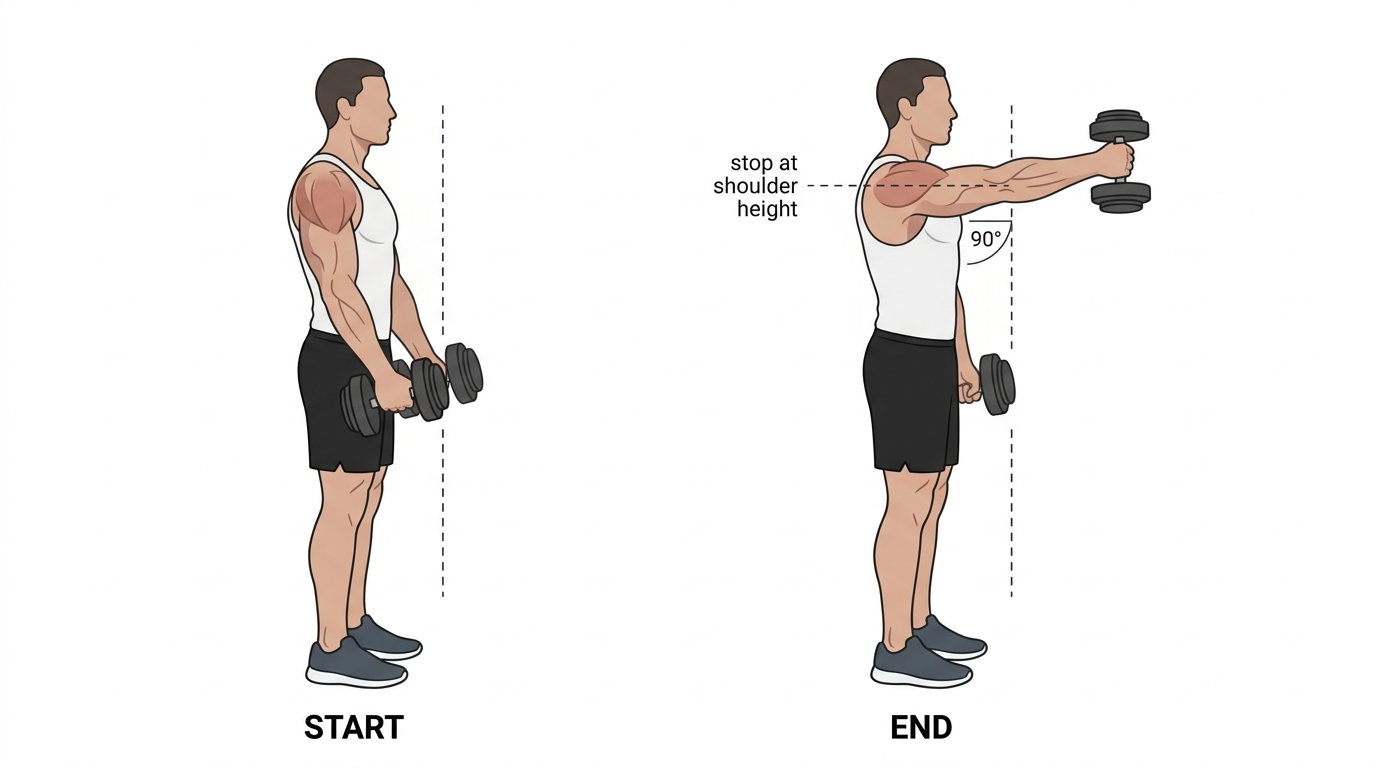
Stand upright with feet shoulder-width apart, knees soft but not bent. Hold a pair of dumbbells in front of your thighs, with palms facing each other (neutral grip is the recommended default for most lifters). Arms hang at full length down, with a slight bend in the elbows.
The slight elbow bend is not just to “save the joints.” Mechanically, it reduces the moment arm at the elbow and prevents the long head of the biceps tendon from carrying load it isn’t designed for. Locked elbows expose the biceps tendon to repeated strain, which can produce overuse irritation over time. Keep about 10 to 15 degrees of flexion at the elbow throughout the lift.
Set the shoulders down and back. Chest up. Core braced. Wrists neutral and in line with the forearms.
Raising
Initiate the lift by raising both dumbbells forward and up in a smooth, controlled arc. Maintain the slight elbow bend throughout. The dumbbells travel in a path that’s roughly parallel to the floor on the way up, with the arms moving primarily at the shoulder joint, not the elbow.
Continue raising until the dumbbells reach shoulder height. Stop there. Do not continue raising the weights above the shoulders, above eye level, or overhead. Raising higher shifts the work from the anterior delt to the upper traps and increases the risk of shoulder impingement.
Keep the wrists neutral throughout. Do not let them bend backward or flop down at the top.
Lowering
Reverse the movement under control. Lower the dumbbells back to the starting position at the front of the thighs. The eccentric phase should be at least as controlled as the concentric, ideally slightly slower. No bouncing at the bottom, no resting the dumbbells on the thighs between reps.
Grip Variations and What They Change
Grip orientation is the most overlooked variable in this lift. Three options, three different recruitment patterns.
Neutral grip (palms facing each other, hammer position). The recommended default for most lifters. Maintains the shoulder in a more neutral position throughout the lift, reduces internal rotation, and produces solid anterior deltoid activation. Easiest on the shoulder joint over time.
Pronated grip (palms facing down). The most common version shown in gym videos. Slightly more anterior delt isolation due to internal rotation of the humerus, but also more shoulder joint stress and a position that’s harder for lifters with any shoulder discomfort. Workable but not ideal as a default.
Supinated grip (palms facing up). Shifts significant work to the biceps and clavicular pec, less to the anterior delt itself. Useful as a variation occasionally, not as a primary version.
For the default front raise prescription in this article, use the neutral grip. If you have any history of shoulder discomfort, the neutral grip becomes even more strongly recommended.
Should You Even Do Front Raises?
The honest answer is: probably less often than you think, and possibly not at all if you train pressing movements regularly.
The anterior deltoid is heavily activated during nearly every pressing exercise. Bench press, incline bench press, overhead press, push-ups, and dumbbell shoulder press all recruit it substantially. A study by Rodríguez-Ridao and colleagues measured EMG activation across five bench press inclinations and found that the anterior deltoid showed its highest activation at the 60-degree incline, with significant activation at all inclinations greater than 45 degrees. The incline bench press in particular trains the anterior delt almost as a co-primary mover alongside the upper chest.
For a lifter who does a regular pressing program (some combination of horizontal pressing and vertical pressing), the anterior delt is already getting substantial weekly training volume. Adding three or four sets of front raises on top of that often pushes total weekly anterior delt volume past the productive zone and into junk volume territory.
The dumbbell front raise is most useful for:
- Lifters with a documented anterior deltoid lag, meaning the front of their shoulder is visibly underdeveloped compared to the chest and side delts
- Lifters who do minimal horizontal or vertical pressing in their programming
- Lifters in shoulder rehab contexts working through a controlled re-strengthening protocol
- Competitive bodybuilders chasing detail and symmetry in advanced phases
The dumbbell front raise is least useful for:
- General strength and physique lifters who already bench press and overhead press regularly
- Lifters trying to build broader shoulders (the medial delt, trained by lateral raises, builds shoulder width, not the anterior delt)
- Beginners and intermediates who have not yet maxed out the productive volume from compound pressing
If you do include front raises in your program, do so deliberately, in low volume, and as a finisher rather than a centerpiece.
Common Dumbbell Front Raise Mistakes
Using too much weight. The single most common error. Heavy dumbbells force momentum, body swing, and incomplete range of motion. The fix is to use lighter weight than feels intuitive and execute every rep deliberately.
Raising above shoulder height. Lifting the dumbbells past the shoulder line shifts work to the upper traps and creates shoulder impingement geometry. The fix is to stop the dumbbells at shoulder height, no higher.
Locked elbows. Straightening the arm completely puts the biceps tendon under strain and increases moment arm unnecessarily. The fix is to maintain a slight, consistent 10 to 15 degree bend in the elbows throughout.
Body sway. Using hip drive or back arching to start the rep is a momentum cheat that defeats the purpose of an isolation lift. The fix is to brace the core, keep the torso still, and reduce the weight if you can’t.
Wrist flop or hyperextension. Allowing the wrists to bend at the top of the rep adds wrist joint stress without benefit. The fix is to keep the wrists neutral and in line with the forearms throughout.
Asymmetric arm height. When using both dumbbells together, one arm often rises higher than the other. The fix is to use a slightly slower tempo and watch your form in a mirror or video occasionally.
Going too fast. The front raise relies on strict tempo to produce muscle tension. Bouncing reps reduce tension and increase risk. The fix is to use a controlled 2-second concentric and 2-second eccentric at minimum.
Working Weight Benchmarks for the Dumbbell Front Raise
Working set weights for 10 to 15 reps with strict form.
Beginner. Men typically work with 5 to 10 kg (10 to 22 lb) per hand. Women typically work with 2 to 4 kg (5 to 9 lb) per hand. At this level the lifter is establishing the movement pattern and feeling out what the anterior delt isolation actually feels like.
Intermediate. Men typically work with 10 to 15 kg (22 to 33 lb) per hand. Women typically work with 5 to 8 kg (10 to 18 lb) per hand. Movement pattern is solid and form holds across multiple sets.
Advanced. Men typically work with 15 to 22 kg (33 to 50 lb) per hand. Women typically work with 8 to 12 kg (18 to 26 lb) per hand. At this level, the lifter has developed real anterior delt strength and uses the lift purposefully.
A critical heuristic: your front raise working weight should be at or below your lateral raise working weight, never substantially above it. The anterior deltoid is anatomically smaller than the medial deltoid (the lateral raise target). If your front raise weight exceeds your lateral raise weight, you are almost certainly using momentum, body sway, or upper trap compensation rather than driving the lift through the anterior deltoid alone.
Programming the Dumbbell Front Raise
If you decide to include this exercise in your routine, for most lifters, 1 to 2 sets per week is the right amount of direct front raise volume. This sounds conservative because it is, and the reason is the overlap with pressing volume covered above. If your program already contains substantial bench pressing and overhead pressing, additional anterior delt isolation has diminishing returns past about 2 weekly sets.
For lifters with documented anterior delt lag or aesthetic bodybuilding goals, 2 to 4 sets per week may be productive. Beyond that, you’re almost certainly into junk volume territory regardless of training experience.
Place front raises late in a shoulder or push session, after primary compound work like the overhead press and after lateral raises. The front raise is the last exercise on the priority list, not the first. The broader rep range principles for muscle growth apply: 10 to 15 reps with weights you can control through full range of motion, sets taken close to failure.
Frequency: 1 to 2 sessions per week is plenty. Daily front raises produce no advantage and accumulate small joint stress over time.
Takeaway
The dumbbell front raise is a useful tool for specific situations: anterior deltoid lag, low-pressing programs, rehab contexts, and advanced symmetry work. For the general lifter doing balanced pressing, it is mostly optional and often replaceable by simply maintaining good pressing volume. Knowing when to include it and when to skip it matters more than knowing how to do it perfectly.
If you decide to include the front raise in your training, do it with intention. Use neutral grip, moderate weight, strict tempo, and stop the dumbbells at shoulder height. Treat it as a small, deliberate finisher rather than a featured lift. Quality and honest programming beat volume and ego on this one.
Frequently Asked Questions
What muscles do dumbbell front raises work?
How heavy should I go on dumbbell front raises?
Should I do front raises and lateral raises both?
Do I need to do front raises if I bench press regularly?
Alternating arm vs both arms together?
Is the dumbbell front raise enough for front delt development?
Continue reading

Barbell Shoulder Press: Form, Muscles Worked & Variations
Master the barbell shoulder press with proper form, bar path mechanics, grip width, and mobility requirements for safe, strong overhead pressing.

Barbell Upright Row: Form, Grip Width, and Safety
Learn proper barbell upright row form, the best grip width, the shoulder impingement risk, and when alternatives like lateral raises are smarter.
Best Compound Exercises for Building Muscle
The best compound exercises for building muscle, organized by movement pattern. Plus how to balance compounds with isolation work.
Free newsletter
Evidence-based fitness and health insights, delivered to your inbox.
No spam. Unsubscribe at any time.
Thanks for subscribing!