Dumbbell Bicep Curl: Form, Muscles, and Programming
Master the dumbbell bicep curl with evidence-based form cues and a programming framework for stronger, bigger biceps.
Medical Disclaimer: This content is for informational purposes only and is not a substitute for professional medical advice. Consult a qualified healthcare provider before starting any new fitness or supplement program.
In this article
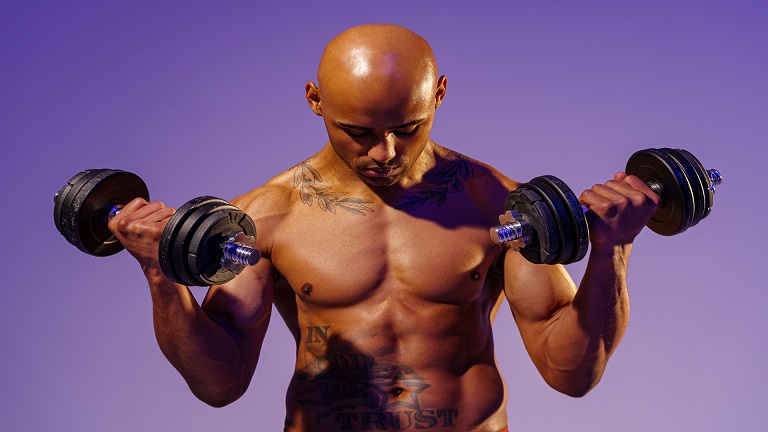
The dumbbell bicep curl is the foundational biceps exercise in any training program, and despite looking simple, most lifters perform it suboptimally because the supination mechanics, the elbow path, and the eccentric tempo are usually glossed over. This guide covers the form cues that actually drive growth, the research on grip orientation, and a programming framework with concrete numbers instead of “do 3 sets of 10.”
What Is the Dumbbell Bicep Curl?
The dumbbell bicep curl is a single-joint isolation exercise performed standing or seated, with a dumbbell in each hand. The lifter starts with arms fully extended at the sides, then flexes the elbows while supinating the forearms, bringing the dumbbells from full extension to full elbow flexion at the shoulders.
It belongs to the broader isolation exercise family that complements compound pulling lifts like rows and pull-ups. Compound pulls build most of the biceps mass through indirect work; curls add the targeted finishing stimulus that pulls cannot fully provide. Both are needed for maximum biceps development. For broader context on dumbbell-based programming, see our guide on strength training with dumbbells.
Muscles Worked by the Dumbbell Bicep Curl
The primary movers are the biceps and the brachialis (a deeper elbow flexor that sits beneath the biceps and adds thickness to the upper arm). The biceps handle elbow flexion combined with forearm supination; the brachialis handles pure elbow flexion regardless of forearm position.
Secondary muscles include the brachioradialis (the forearm muscle on the thumb side that contributes to elbow flexion), the forearm flexors (grip), and the front delts (assist with arm flexion at the start of the rep). The dumbbell curl looks like a pure biceps exercise but recruits the entire elbow flexor group along with grip and shoulder stabilizers.
How to Perform the Dumbbell Bicep Curl
Setup
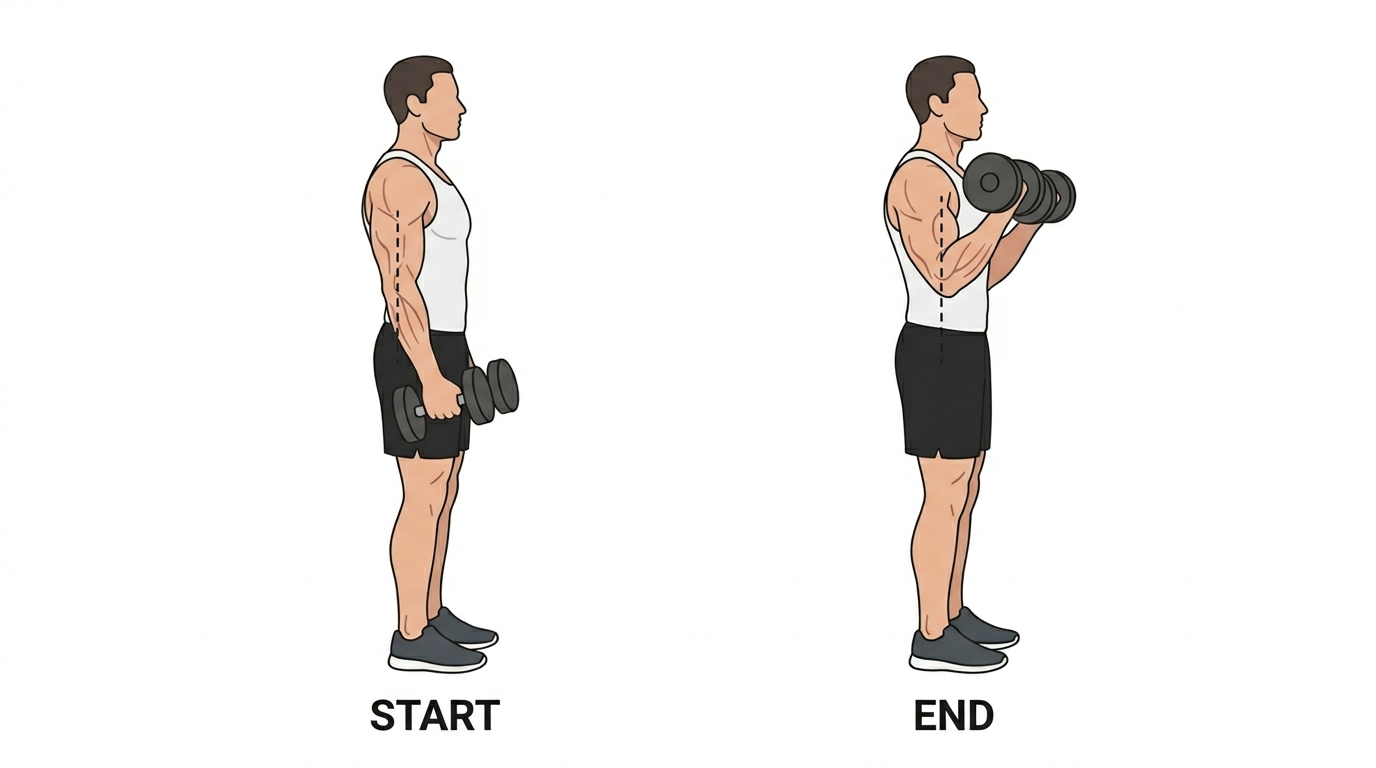
Stand upright with your feet hip-width apart. Hold a dumbbell in each hand with arms fully extended at the sides. Grip the dumbbells with a neutral hand position (palms facing the thighs) at the start.
Pull your shoulders back and down (active scapular retraction). Brace your core. Chin level, eyes forward. Both elbows tucked against the sides of the torso, slightly forward of the line of the body so the biceps are lightly preloaded at the start.
The setup is the foundation. A sloppy starting position turns into a sloppy first rep, which turns into a sloppy set. Take the extra 2 seconds to get the shoulders and elbows positioned before starting.
Coming Up
Begin the curl by flexing the elbows. As the dumbbells rise, rotate the forearms from neutral to fully supinated. By the time the dumbbells reach hip height, the palms should be facing up.
Continue curling until the dumbbells reach the shoulders, with full elbow flexion and full supination. Squeeze the biceps hard at the top for a brief moment. The biceps should be in their fully shortened, fully contracted position.
The elbows can drift slightly forward at the top of the rep. This brings the biceps to a more shortened position and increases peak contraction, so it is acceptable.
Going Down
Lower the dumbbells in a controlled descent over 2 to 3 seconds. Rotate the forearms back from supinated to neutral as the dumbbells descend. The arms should reach full extension at the bottom, not just “almost.”
Pause briefly at full extension to eliminate any reflexive bounce. The biceps should feel stretched at the bottom. Do not drop the dumbbells back to the start position. The eccentric is where most of the growth stimulus lives, and rushing it loses half the productive work of each rep.
Common Form Mistakes (and How to Fix Them)
Swinging the dumbbells: the most common error and the one that turns a biceps exercise into a momentum exercise. Fix: drop the load by 20 to 30% and rebuild from there with strict form. Strict form on lighter loads beats loose form on heavier loads for biceps growth, every time.
Not fully extending at the bottom: cutting the bottom of the range of motion is the more common error than cutting the top, and it costs more growth. Fix: lower until the arms are fully straight, biceps stretched. Pause briefly at the bottom to eliminate any reflexive bounce.
Skipping supination: curling with the palms held in a fixed position throughout the rep (effectively a hammer curl) reduces biceps activation by 12 to 19%. Fix: rotate the forearms from neutral at the bottom to fully supinated at the top of every rep.
Shoulders rolling forward: when the shoulders protract during the curl, the upper arm angles forward and the biceps end up in a disadvantaged starting position. Fix: retract and depress the shoulder blades before the first rep, and check the chest stays high throughout the set.
Rushing the eccentric: dropping the dumbbells back to the start loses half the productive work of each rep. Fix: lower over 2 to 3 seconds, controlling the descent. The eccentric is where most isolation-lift growth happens.
Lifting the dumbbells too high: curling past full elbow flexion (bending forward at the shoulder to “finish” the rep) shifts load to the front delts and reduces biceps tension. Fix: stop the curl at the natural top, with the dumbbells near the shoulders and the elbows at the side or slightly forward. Going further is shoulder flexion, not elbow flexion.
How to Program Dumbbell Bicep Curls
The dumbbell bicep curl fits naturally on pull day, arm day, or as accessory work after compound pulling lifts (rows, pull-ups, lat pulldowns). The biceps are already worked as a secondary muscle in compound pulls, so curls function as a finishing stimulus rather than a primary lift. Pairs naturally with the barbell bent over row and other pulls in the same session.
For hypertrophy, which is the primary goal for most lifters doing curls, 3 to 4 sets of 8 to 12 reps at moderate load. The biceps respond well to higher rep ranges (10 to 15 reps) because the muscle has a relatively high concentration of slow-twitch fibers that handle higher volumes well. Total weekly volume of 12 to 20 sets per week for biceps including all curl variants and the indirect work from compound pulls is a reasonable target. The fuller breakdown on rep ranges for muscle growth applies here.
Most lifters benefit from training biceps 2 to 3 times per week. The biceps recover quickly from training (24 to 48 hours for most lifters), which supports higher frequency than larger muscle groups like the chest or back. Going beyond 3 sessions per week is rarely necessary and risks elbow joint overuse over time.
Working Weight Benchmarks (per dumbbell)
Beginner: 0.10 to 0.15 times bodyweight per dumbbell for 10 to 12 reps. For a 75 kg (165 lb) lifter, that is roughly 7.5 to 11 kg (15 to 25 lb) per hand.
Intermediate: 0.15 to 0.25 times bodyweight per dumbbell for 8 to 10 reps. Same 75 kg lifter: 11 to 19 kg (25 to 40 lb) per hand.
Advanced: 0.25 to 0.35 times bodyweight per dumbbell or more for 6 to 8 reps. 75 kg lifter: 19 to 26 kg or more (40 to 60 lb+) per hand.
Progression Scheme
Once you hit the top of your rep range across all working sets, add 1 kg or 2.5 lb per dumbbell the following session and drop back to the bottom of the rep range. Repeat the cycle. Smaller jumps are appropriate here than on compound lifts because absolute biceps strength is lower. A 2.5 kg jump per hand can represent a 15 to 25% load increase, which often causes form breakdown. Use micro-plates if available, or alternate between rep range targets within the same dumbbell weight.
Alternating vs Simultaneous Curls
Both are valid. Alternating (one arm at a time) allows slightly heavier loads because each arm gets a brief rest while the other works. Simultaneous (both arms together) reduces total set time and increases the metabolic challenge of the set. Choose based on the goal: alternating for max load and strict form, simultaneous for time efficiency and intensity.
Standing vs Seated
The dumbbell bicep curl can be performed standing or seated, with each position serving a slightly different purpose.
Standing
The standard variation. Both feet planted, both arms working. Allows the most natural movement pattern and the heaviest absolute loads. The downside: easier to swing or use momentum if form gets sloppy. Standing is the default for most lifters most of the time.
Seated (on a flat or incline bench)
Reduces the ability to swing because the lower back is supported and the torso cannot lean back. Forces stricter form and isolates the biceps more directly. Particularly useful for lifters who tend to cheat on standing curls, or as a finisher after the heavier standing work. An incline bench set at 60 to 75 degrees also adds a slight stretch to the biceps at the bottom, which some lifters prefer.
For most lifters, the practical recommendation: standing for the working sets, seated for the finishing sets when grip and lower back fatigue start affecting form on the standing reps.
Should You Use Wrist Wraps for Dumbbell Bicep Curls?
Most lifters do not need wrist wraps for curls. The forearm and grip get worked alongside the biceps, and that is a feature of the lift, not a flaw. Building grip strength as a byproduct of biceps work is useful for every other lift in the program.
At very heavy loads (above 25 kg per dumbbell), some lifters use light wraps for wrist stability, but this is uncommon and rarely necessary. If wrists hurt during curls, the cause is usually bent-back wrist position rather than insufficient support. Keep the wrists in line with the forearm throughout the rep and most wrist discomfort resolves without needing wraps.
Takeaway
The dumbbell bicep curl is simple to learn, and works equally well for beginners and experienced lifters at any training level. The technique is forgiving once the supination, elbow position, and eccentric tempo are dialed in, and the lift fits nicely into almost any training program.
Frequently Asked Questions
Are dumbbell bicep curls enough to grow biceps?
How heavy should I go on dumbbell bicep curls?
Should I do dumbbell curls standing or seated?
How often should I do dumbbell bicep curls per week?
Do I need to fully extend at the bottom of every rep?
Continue reading
Cable Lateral Raise: Form, Muscles, and Programming
The cable lateral raise isolates the side delt while providing constant tension. Learn the form, the muscles worked, and how to program it.
Barbell Shrugs: Proper Form and Muscles Worked
Barbell shrugs build the upper traps faster than almost any move. Learn proper form, muscles worked, grip strategy, and how to program them.
Dumbbell Front Raise: Form, Grip, and When to Skip
Learn proper dumbbell front raise form, grip variations, and when this lift is actually worth doing versus a waste of training volume.
Free newsletter
Evidence-based fitness and health insights, delivered to your inbox.
No spam. Unsubscribe at any time.
Thanks for subscribing!