Dumbbell Incline Curl: Form, Muscles, and Programming
Master the dumbbell incline curl with evidence-based form cues, the right bench angle, and a programming framework for long-head biceps development.
Medical Disclaimer: This content is for informational purposes only and is not a substitute for professional medical advice. Consult a qualified healthcare provider before starting any new fitness or supplement program.
In this article
The dumbbell incline curl is the most effective biceps exercise for emphasizing the long head, the part of the biceps that creates the visible peak. Despite being called “just a variation of the dumbbell curl,” most lifters perform it badly because the elbow position, bench angle, and eccentric tempo are critical and usually glossed over. This guide covers the biomechanical reason it works, the bench angle decision, and a programming framework that fits the exercise’s specific role.
What Is the Dumbbell Incline Curl?
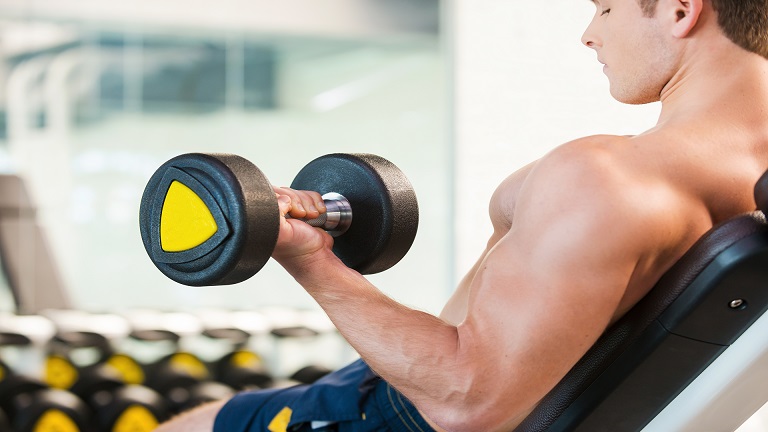
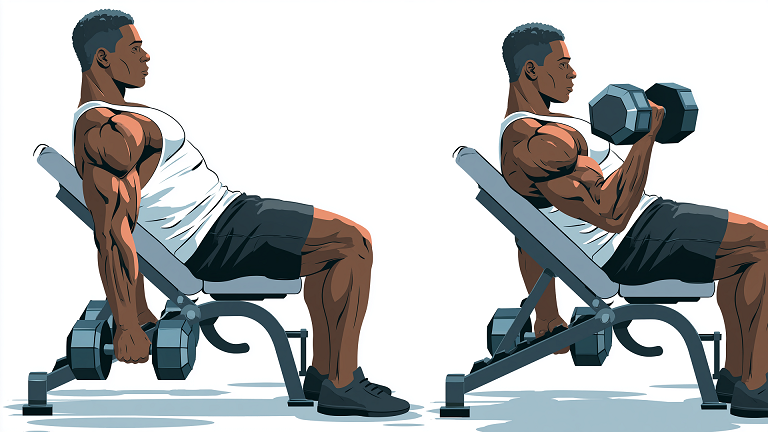
The dumbbell incline curl is a single-joint isolation exercise performed lying back on an incline bench (typically 45 to 60 degrees). The lifter’s arms hang straight down with the upper arms positioned behind the line of the torso. From there, the dumbbells curl from full extension to full elbow flexion, then return under control.
It belongs to the broader biceps isolation family along with the standard dumbbell bicep curl, preacher curl, and concentration curl. The incline curl is the variation that biases the long head of the biceps by placing the muscle in a stretched starting position. It complements the standard curl rather than replacing it. Compound pulls and standard curls build most of the biceps mass; the incline curl adds the targeted long-head stimulus that those exercises cannot provide as effectively. For broader context on dumbbell-based programming, see our guide on strength training with dumbbells, and for the foundational compound work that drives biceps mass, see compound exercises for building muscle.
Muscles Worked by the Dumbbell Incline Curl
The primary movers are the biceps, with explicit emphasis on the long head (the outer head of the biceps brachii that contributes most of the visible bicep peak), and the brachialis (a deeper elbow flexor that sits beneath the biceps and adds thickness to the upper arm).
Secondary muscles include the brachioradialis (the forearm muscle on the thumb side), the forearm flexors (grip), and the front delts (minor involvement, only at the very start of the rep). The lift is more selective than the standard curl because the bench position locks the upper arm in shoulder extension, preventing the front delts from helping with the curl.
Why the Incline Position Targets the Long Head
The biceps long head crosses both the shoulder joint AND the elbow joint, which means its length depends on positions at both joints. When the shoulder is in extension (arm behind the body, like in the incline curl starting position), the long head is stretched. Curling from that stretched position recruits more long head fibers than a standard curl can, where the upper arm hangs vertically and the long head starts at neutral length.
How to Set the Bench Angle
The bench angle is the article’s main practical decision and a real trade-off, not just personal preference.
45 degrees
Deepest stretch on the long head. The arms sit further behind the body, which maximizes the long-muscle-length stimulus. Recommended for hypertrophy-focused training and lifters specifically targeting bicep peak development. Demands more shoulder mobility and patience with lighter loads.
60 degrees
The middle ground and most common default. Slightly less stretch than 45 degrees, but more comfortable shoulder positioning and slightly heavier loads. A reasonable starting point for most lifters new to the exercise.
65 to 75 degrees
Closer to an upright seated curl, with reduced stretch on the long head. Recommended for lifters with shoulder discomfort at lower angles, or when the focus shifts toward heavier load over deeper stretch. Anything steeper than 75 degrees and the exercise loses its distinctive benefit.
The practical recommendation
Start at 60 degrees as the comfortable middle ground. Drop to 45 degrees when the goal is maximum long-head emphasis and shoulder comfort allows it. Move to 65 to 75 degrees if 45 to 60 causes shoulder discomfort.
A note on bench quality: a sturdy adjustable bench with positive angle locks matters here. A wobbly bench at 45 degrees with heavy dumbbells is genuinely dangerous because escape from a failed rep is harder when reclined. If you’re training at home and your bench wobbles, see our guide on the best adjustable weight bench for upgrade options.
How to Perform the Dumbbell Incline Curl
Setup
Set the bench to 45 to 60 degrees. Sit on the bench and lay back firmly against the backrest, with your shoulders, upper back, and lower back all in contact with the pad. Plant your feet flat on the floor.
Pick up the dumbbells (or have a spotter hand them over). Let the arms hang straight down at the sides. Because of the reclined position, the arms naturally hang BEHIND the line of the torso. This is the defining feature of the exercise: shoulders in slight extension, biceps stretched at the bottom.
Grip the dumbbells with a neutral hand position at the start. Head can rest gently against the backrest or be held in a comfortable neutral position with the chin slightly tucked. Brace the core. Do NOT raise the upper arms forward; the elbows should point toward the floor throughout the rep.
Coming Up
Begin the curl by flexing the elbows. As the dumbbells rise, rotate the forearms from neutral to fully supinated. By the time the dumbbells reach mid-rep, the palms should be facing up.
The upper arm MUST stay back (in shoulder extension) throughout the rep. If the elbow drifts forward, the long head stops being stretched and the exercise reverts to a poor seated curl with the bench getting in the way. The whole point of the bench is to lock the upper arm in a fixed extended position relative to the body.
Continue curling until full elbow flexion, with the dumbbells near the shoulders. Squeeze the biceps hard at the top briefly. Resist the temptation to bring the elbow forward to “finish” the rep; that’s shoulder flexion, not elbow flexion, and it removes the long-head stimulus.
Going Down
Lower the dumbbells over 3 to 4 seconds, slower than you’d lower on a standard curl. The eccentric is critical here because the biceps are loaded at a long muscle length, where the stretch-mediated hypertrophy stimulus is highest.
Rotate the forearms back from supinated to neutral as the dumbbells descend. The arms reach full extension at the bottom: elbow nearly straight, biceps maximally stretched. Pause briefly at full extension to eliminate any reflexive bounce. Do not drop the dumbbells back to the start.
Common Form Mistakes (and How to Fix Them)
Letting the elbow drift forward during the curl: the most common error and the one that turns an incline curl into a poorly-executed seated curl. Fix: consciously keep the upper arm pointing toward the floor throughout the rep. The elbow stays back, not forward. If keeping it back is difficult, the load is too heavy.
Cutting the bottom of the range of motion: stopping short of full extension defeats the entire point of the exercise. Fix: lower until the arms are fully straight, biceps maximally stretched. Pause briefly at the bottom to eliminate any reflexive bounce. If full extension hurts, drop the load and rebuild.
Bench angle too steep: above 70 degrees, the arms come closer to vertical and the long head loses its stretch. Fix: set the bench at 45 to 65 degrees. Steeper than that and you might as well do a seated curl on a flat bench.
Rushing the eccentric: dropping the dumbbells back to the start loses the stretch-mediated hypertrophy stimulus that makes this exercise valuable. Fix: lower over 3 to 4 seconds, even slower than on standard curls. This is the rep that matters most on this lift.
Hyperextending the lower back to help the curl: when the load is too heavy, lifters arch the lower back off the bench to recruit additional muscles. Fix: keep the entire back in contact with the bench throughout the set. If the back arches, the load is too heavy.
How to Program Dumbbell Incline Curls
The dumbbell incline curl fits naturally on pull day, arm day, or as accessory work after compound pulling lifts and the standard dumbbell curl. It pairs particularly well with the standard dumbbell curl since the two lifts hit different mechanical environments of the same muscle. Standard curls let you load heavier and lean into the short-head bias, incline curls force a long-head stretch under strict form. Programming both across the week works well: heavy standard curl one day, incline curl with slow eccentrics another. Programming both in the same workout also works well for hypertrophy-focused training, just lead with the standard curl while you’re fresh and finish with the incline variation.
For hypertrophy, which is the primary goal for most lifters doing incline curls, 3 to 4 sets of 8 to 12 reps at moderate load. The exercise also pairs cleanly with horizontal pulling work like the barbell bent over row, which already trains the biceps as a major secondary mover. You can also check our guide on rep ranges for muscle growth.
Working Weight Benchmarks (per dumbbell)
Beginner: 0.08 to 0.12 times bodyweight per dumbbell for 10 to 12 reps. For a 75 kg (165 lb) lifter, that is roughly 6 to 9 kg (15 to 20 lb) per hand.
Intermediate: 0.12 to 0.20 times bodyweight per dumbbell for 8 to 10 reps. Same 75 kg lifter: 9 to 15 kg (20 to 35 lb) per hand.
Advanced: 0.20 to 0.30 times bodyweight per dumbbell or more for 6 to 8 reps. 75 kg lifter: 15 to 22 kg or more (35 to 50 lb+) per hand.
Progression Scheme
Once you hit the top of your rep range across all working sets, add 1 kg or 2.5 lb per dumbbell the following session and drop back to the bottom of the rep range. Use micro-plates if available, since small jumps preserve form on this exercise. Smaller jumps are even more important on the incline curl than on the standard curl because there is less margin for form breakdown when momentum is removed from the equation.
Takeaway
Biceps growth comes from a combination of standard curls, incline curls, and compound pulls. Each contributes a piece the others cannot fully provide. The incline curl specifically adds the long-head emphasis through stretched-position training, which the standard curl and compound pulls do not target as effectively. Run all three consistently, control the eccentric, train with strict form, and pair the work with adequate recovery and protein intake for muscle growth.
Frequently Asked Questions
What's the best bench angle for incline dumbbell curls?
How heavy should I go on incline dumbbell curls?
Should I do incline curls instead of standard curls?
Why do incline curls feel harder than regular curls?
How often should I do incline dumbbell curls per week?
Continue reading
Cable Lateral Raise: Form, Muscles, and Programming
The cable lateral raise isolates the side delt while providing constant tension. Learn the form, the muscles worked, and how to program it.
Barbell Shrugs: Proper Form and Muscles Worked
Barbell shrugs build the upper traps faster than almost any move. Learn proper form, muscles worked, grip strategy, and how to program them.
Dumbbell Front Raise: Form, Grip, and When to Skip
Learn proper dumbbell front raise form, grip variations, and when this lift is actually worth doing versus a waste of training volume.
Free newsletter
Evidence-based fitness and health insights, delivered to your inbox.
No spam. Unsubscribe at any time.
Thanks for subscribing!